
Learn everything about capital gains tax Malaysia 2024, including rates, exemptions, RPGT differences, and compliance steps for companies and LLPs.
Learn everything about capital gains tax Malaysia 2024, including rates, exemptions, RPGT differences, and compliance steps for companies and LLPs.
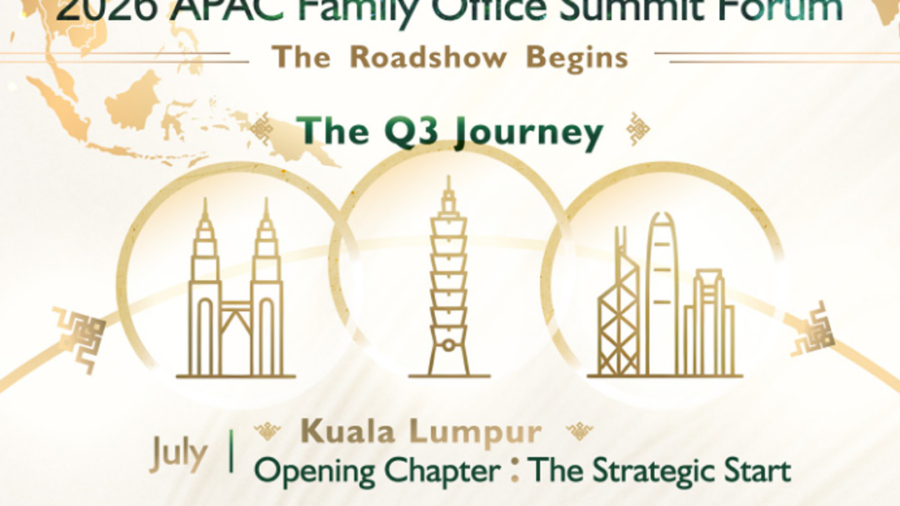
We are proud to announce the return of the
APAC Family Office Summit Forum 2026 🌏
The true value of wealth lies in its ability to endure across generations.
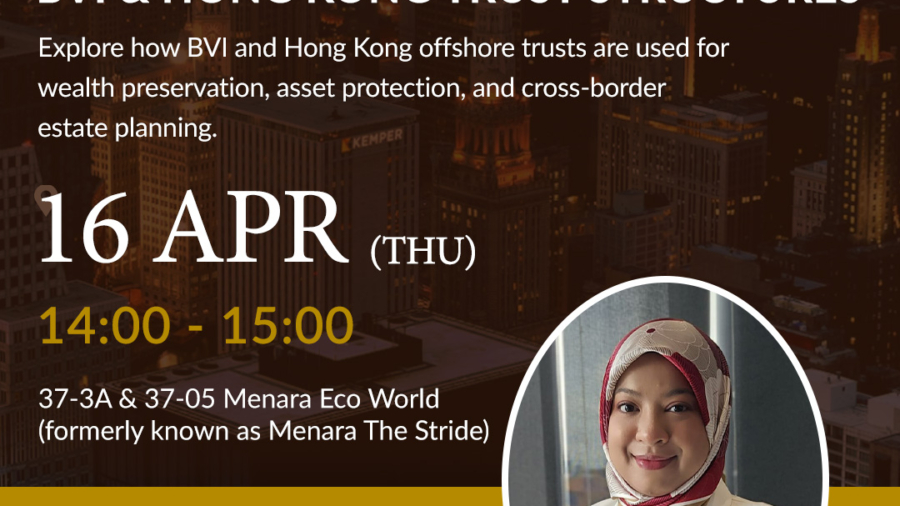
Offshore trust structures have become central pillars in modern wealth preservation, especially for families operating across multiple jurisdictions. This session clarifies how BVI and Hong Kong trust frameworks support long-term protection, governance continuity, and tax-efficient asset allocation in an increasingly complex global environment.
Discover how Timeless Trust Banking System supports wealth protection, seamless banking integration, and long-term succession planning for individuals and families seeking greater control and clarity.
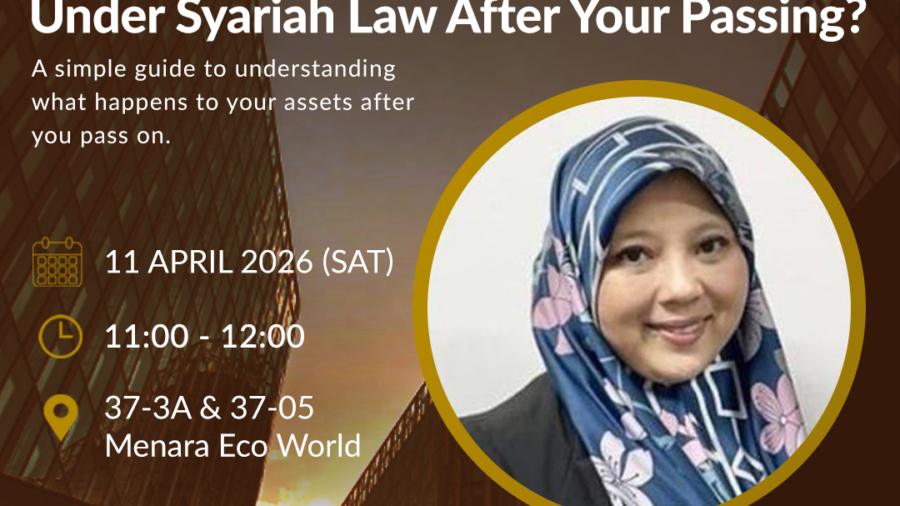
Join Ms. Julia as she explains what happens to your assets under Syariah law after your passing. Learn how Faraid determines the distribution of your estate, who your rightful heirs are, and how proper planning can help ensure a smooth and compliant wealth transfer for your loved ones.
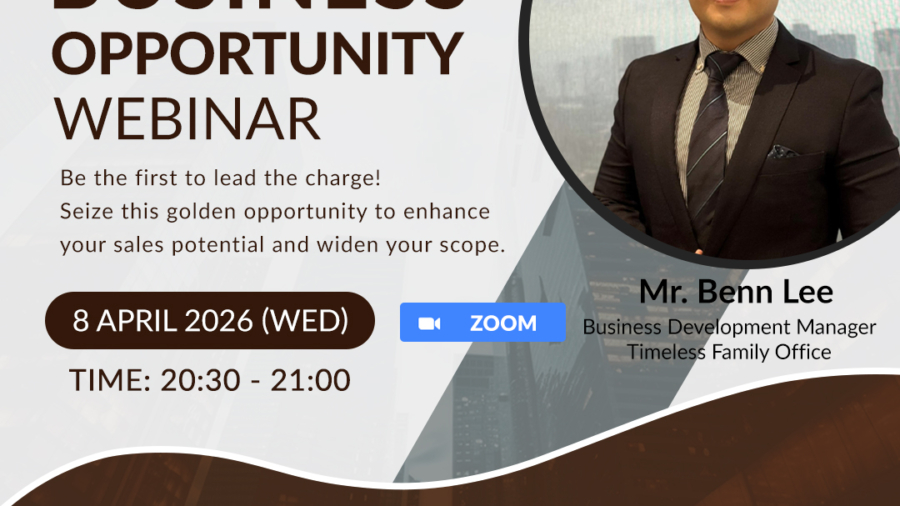
Be the first to lead the charge! Seize this golden opportunity to enhance your sales potential and widen your scope.

SFO Malaysia Made Simple: How to Apply, What It Costs, and Why Families Are Moving Fast
A family office for business owners is not a replacement for your company—it is a governance layer built around it. For founders with RM30 million or more in family assets, Malaysia’s Single Family Office (SFO) framework at Forest City SFZ allows you to retain full decision-making control over investments, succession, and legacy—while accessing a 0% tax rate for up to 20 years. This guide explains how to structure a family office for business owners so the founder remains firmly in the driver’s seat.
Most family offices globally were created by entrepreneurs and business founders. According to research by Heidrick & Struggles, the typical pattern begins after a significant liquidity event—a partial exit, an IPO, or the sale of a division—when the founder suddenly has investable capital that needs a permanent home.
But many Malaysian founders face a more nuanced situation. They have not sold their business. The operating company is still generating wealth. What they need is not a post-exit structure, but a parallel structure that manages family wealth while the business continues to grow.
This is exactly the scenario Malaysia’s SFO Incentive Scheme was designed for. Under the Forest City SFZ framework, a founder can establish a Single Family Office Vehicle (SFOV) as a separate investment holding company—wholly owned by family members—without disrupting the operating business. The SFO manages the SFOV’s investments, while the founder retains strategic control over both entities.
The critical advantage: You do not need to sell or restructure your core business to qualify. You simply need RM30 million in assets under management within the SFOV and a physical presence in Forest City.
New to the concept? Start here: reasons to know about a family office in Malaysia .
Under Malaysia’s Securities Commission (SC) guidelines, the SFO framework consists of two corporate entities:
| Entity | Role & Function |
|---|---|
| SFO (Management Company) | The operational arm. Employs the investment professionals, conducts research, executes investment decisions, and provides administrative services to the family. Must operate from Pulau 1, Forest City SFZ. |
| SFOV (Investment Vehicle) | The asset-holding entity. A newly incorporated Malaysian company, wholly owned by family members. Holds the family’s investments and receives the 0% concessionary tax rate on qualifying income. |
This two-entity model is the backbone of a family office for business owners who want control without disrupting operations The founder typically controls both entities through direct or indirect shareholding. The SC does not mandate that external parties hold equity. As long as the SFO exclusively serves its related SFOV (not external clients), it is exempt from requiring a fund management licence under the Capital Markets and Services Act 2007 (CMSA).
Key principle: The founder’s operating business sits outside the SFO/SFOV structure entirely. The operating company continues as before. The SFOV is funded with family capital—dividends, retained earnings, personal savings, or asset transfers.
In a family office for business owners, control is documented—not assumed. A common concern among entrepreneurs is that establishing a family office means surrendering control. In practice, the SFO framework gives founders formal tools to retain and codify their authority.
As the sole or majority shareholder of both the SFO and the SFOV, the founder appoints directors, approves investment mandates, and retains veto power over strategic decisions. Under the Malaysian Companies Act 2016, the founder has ultimate authority over board composition.
A written IPS sets the boundaries for the investment professional. It defines asset allocation targets, risk tolerance, prohibited sectors, and return expectations. It is the founder’s rulebook—staff execute within parameters, but the founder sets the strategy.
The charter formalises how decisions are made across generations. It specifies voting rights, how the next generation earns authority, dispute resolution, and distributions. It transitions the family from informal arrangements to documented governance.
The founder can delegate day-to-day portfolio management to the investment professional while reserving approval rights for decisions above certain thresholds—for example, any single investment exceeding RM2 million.
Rather than fixing a date to "step back", documents can define event-based triggers for control transfer: incapacity, voluntary retirement, or achievement of specific milestones by the next generation. This keeps the founder in control until a deliberate transition occurs.
To qualify, a family office for business owners must meet substance and AUM thresholds through the SFOV. The Forest City SFO Incentive Scheme has specific entry requirements. The table below summarises the key conditions for the initial 10-year period and the extended period:
| Requirement | Initial Period (10 Years) | Extended Period (+10 Years) |
|---|---|---|
| Minimum AUM | RM30 million (~US$7.1M) | RM50 million (~US$11.8M) |
| Tax Rate on Qualifying Income | 0% | 0% |
| Local Investment | 10% of AUM or RM10M (whichever is lower) | 10% of AUM or RM10M (whichever is higher) |
| Full-Time Employees | Minimum 2 (incl. 1 Investment Professional) | Minimum 4 |
| Annual Local OPEX | RM500,000 (~US$118K) | RM650,000 (30% increase) |
| Location | Pulau 1, Forest City SFZ | Pulau 1, Forest City SFZ |
| IP Salary Minimum | RM10,000/month | RM10,000/month |
Source: Securities Commission Malaysia, SFO Incentive Scheme Guidelines (October 2025); EY Tax Alert No. 3/2025.
These three scenarios illustrate how different types of founders can use the SFO structure practically:
Situation: Still running the operating company. Has accumulated RM40M+ in personal/family investments outside the business.
SFO Application: Sets up SFOV to hold non-business investments. Appoints a trusted CIO within the SFO. Retains veto on all major allocations via the IPS.
Situation: Recently sold the business or a major stake. Liquid wealth exceeds RM100M. Considering Singapore vs Malaysia.
SFO Application: Uses Malaysia’s lower OPEX and AUM thresholds for cost efficiency. May maintain a banking satellite in Singapore for global access.
Situation: G2 family member taking over. Wants to professionalise wealth management separate from the legacy business.
SFO Application: Establishes the SFO with G1’s capital. Governance charter defines how G2 earns expanded authority. G1 retains oversight via board seat.
The financial case for the Forest City SFO is straightforward. Qualifying investment income—including capital gains, dividends, and foreign-sourced income—is taxed at 0% for up to 20 years. In a typical scenario, a founder transferring RM50 million in unlisted shares into the SFOV would benefit from:
For comparison, a Malaysian-resident founder currently pays up to 30% personal income tax and 24% corporate tax. An SFO in Singapore would require at least S$20 million (~RM65 million) in AUM for the Section 13O incentive, with higher annual operating expenditure thresholds. The Forest City scheme is specifically designed to be accessible to founders who are building wealth, not just those who have already accumulated it at scale.
Based on current SC processes and early implementation experiences, the following timeline is typical:
| Phase | Activity | Duration |
|---|---|---|
| Phase 1 | Preliminary eligibility review with SC; engage legal and tax advisors | 2–4 weeks |
| Phase 2 | Incorporate SFOV and SFO management company; prepare governance documents (IPS, charter) | 4–6 weeks |
| Phase 3 | Pre-registration with SC for tax incentive eligibility; transfer assets to SFOV | 4–8 weeks |
| Phase 4 | Hire investment professional(s); set up Forest City office; commence operations | 2–4 weeks |
| Total | Decision to fully operational SFO | 3–5 months |
If you want the full step-by-step checklist, see: how to set up a family office in Malaysia .
For founders with cross-border interests, the choice between Malaysia and Singapore need not be binary. A growing number of families are adopting a "twin-engine" approach:
This structure leverages Malaysia’s cost advantage (operational costs are roughly 65% lower than Singapore) while retaining access to Singapore’s deeper financial infrastructure. The Johor-Singapore Special Economic Zone (JS-SEZ) further supports this dual-hub model by facilitating movement of goods, people, and capital between the two jurisdictions.
Establishing an SFO is a strategic commitment, not a tax shortcut. The following missteps can undermine both the structure and the founder’s objectives:
For business founders, a family office for business owners is not about giving up control—it is about institutionalising it. The Forest City SFO framework provides the legal, tax, and governance infrastructure to separate personal wealth management from the operating business, protect assets across generations, and ensure that the founder’s vision endures beyond their active involvement.
The structural advantage is clear: 0% tax for 20 years, lower entry barriers than Singapore, and full founder control through corporate shareholding and governance documentation. The question is not whether to establish an SFO, but how to structure it so that it serves the founder’s purpose from day one.
Yes. Under Malaysia's Forest City SFO Incentive Scheme, the founder can be the sole or majority shareholder of both the SFO (management company) and SFOV (investment vehicle). The founder appoints directors, sets the Investment Policy Statement, and retains veto power over all strategic decisions. No external equity holders are required.
The SFOV must hold assets under management (AUM) of at least RM30 million (~US$7.1 million) during the initial 10-year incentive period. For the extended 10-year period, the minimum increases to RM50 million. This is significantly lower than Singapore's S$20 million (~RM65 million) threshold for the 13O incentive.
No. The SFOV is a separate investment holding company that sits alongside the operating business. The founder funds the SFOV with family capital—dividends, retained earnings, personal savings, or asset transfers—without restructuring or selling the core business.
Qualifying SFOVs pay a 0% concessionary tax rate on investment income, capital gains, foreign-sourced income, and dividend distributions for an initial 10 years, extendable for another 10 years. One-off exemptions also apply to capital gains tax on unlisted share transfers and stamp duty on asset transfers into the SFOV.
From decision to fully operational SFO, the typical timeline is 3 to 5 months. This includes preliminary eligibility review with the Securities Commission (2–4 weeks), incorporation and governance documentation (4–6 weeks), SC pre-registration and asset transfer (4–8 weeks), and office setup with hiring (2–4 weeks).
Yes. A growing number of families adopt a "twin-engine" strategy: domiciling the SFOV in Malaysia's Forest City for the 0% tax rate and lower operational costs, while maintaining a banking satellite in Singapore for global market access and deal flow. The Johor-Singapore Special Economic Zone (JS-SEZ) supports this dual-hub approach.
Disclaimer: This content is published by the Family Inheritance Association of Malaysia (FIAM) for educational and policy analysis purposes only. It does not constitute licensed financial, legal, or tax advice. Readers should consult qualified professionals before making any decisions regarding family office structures, tax planning, or investment management.
Transitioning to an SFO is a pivotal step in your legacy. Timeless Family Office, in collaboration with FIAM, is offering a complimentary strategy session to help you map out your control, governance structure, and eligibility for the Forest City incentives in 2026.
*Daily slots are limited. Please mention “FIAM Founder Guide” when booking.
Compare Forest City SFO (0% tax), Labuan trusts and offshore trusts. See AUM, substance, costs, layering strategies and best fit for Malaysians in 2026.
The global family office sector is expanding rapidly — and Malaysia is now positioning itself as one of Asia’s next major family office hubs. From 0% tax incentives to the new Special Financial Zone, 2026 marks a critical turning point.
Here’s everything you need to know about why Family Office in Malaysia is gaining attention now, what opportunities exist, and why talent and readiness remain key challenges.
The global family office sector has grown significantly, managing approximately $3.1 trillion in assets (2024), with projections estimating an increase to $5.4 trillion by 2030.
Notably, the Asia-Pacific region has surpassed Europe in the number of family offices, hosting 2,290 compared to Europe’s 2,020. This highlights Asia’s rising prominence in wealth creation and long-term family governance.
Asia is now the fastest-growing region for ultra-high-net-worth families, driving new demand for advisors, governance experts, and compliant wealth structures.
In Malaysia, 2026 marks a turning point. The Madani Government has introduced the Family Office Incentive Scheme and established the Forest City Special Financial Zone (SFZ), signaling a strong commitment to positioning Malaysia as a competitive family office hub in Southeast Asia.
Below are the key reasons why understanding the family office landscape in Malaysia matters now.
On 20 September 2024, the Malaysian government launched a new Family Office Incentive Scheme under the Forest City Special Financial Zone (SFZ), offering a 0% tax rate for up to 20 years to eligible Single Family Office Vehicles (SFOV1).
| Key Benefits | Description |
|---|---|
| Zero Percent Tax Rate | 20-year tax exemption on income from eligible investments |
| Strategic Location | Must operate within Forest City SFZ with future-ready infrastructure |
| AUM Requirement | Minimum RM30 million assets under management |
| Local Investment | At least 10% of AUM or RM10 million invested locally |
| Operational Spending | Minimum RM500,000 annual OPEX in Malaysia |
For full guidelines, visit the Securities Commission Malaysia announcement .
These incentives raise an important question: Does Malaysia have enough talent, advisory readiness, and ecosystem support to manage the incoming and existing wealth? Today, the answer is largely — not yet.
If you are exploring an international family office, one of Asia’s top firms has now set up in Malaysia. You may make an appointment to speak with their consultant.
Globally, family offices demonstrate massive long-term gains in wealth preservation, governance, and tax optimisation. Here are real examples showing why they matter:
If you are exploring strategic wealth structuring, you may want to review: How to Set Up an Offshore Trust in Malaysia .
By 2027, Asia is expected to have approximately 210,000 ultra-high-net-worth individuals (UHNWIs), each with at least USD 30 million (RM141 million) in wealth. This reflects a growth of nearly 40% from 2022.
With this surge, Asia’s demand for governance advisors, succession planners, trust specialists, and multi-jurisdiction wealth experts is outpacing supply — especially in Malaysia.
This widening talent gap creates opportunities for advisors, financial planners, lawyers, trust officers, and next-gen owners to upskill.
Many high-net-worth individuals in Asia manage their wealth through family offices located in Singapore or Hong Kong. Below is a snapshot of notable individuals with Asia-based family offices:
| Name | Net Worth (2025) | Description | Country | Industry | Family Office Name | Major Investments | Philanthropy | Year Established | Education | Awards |
|---|---|---|---|---|---|---|---|---|---|---|
| Sergey Brin | $143 billion | Co-Founder of Google | Singapore | Technology | Brin Family Office | Real estate, AI startups | Brin Wojcicki Foundation | 2005 | Stanford University | Marconi Prize, National Medal of Technology |
| Mukesh Ambani | $104 billion | Chairman of Reliance Industries | Singapore | Energy, Retail | Reliance Family Office | Oil, telecom, retail | Reliance Foundation | 1981 | Institute of Chemical Technology | Business Leader of the Year |
| Liang Xinjun | $2.3 billion | Co-founder of Fosun Group | Singapore | Investment | Fosun Family Office | Healthcare, real estate | Fosun Foundation | 1992 | Fudan University | Top 10 Chinese Entrepreneurs |
| Ray Dalio | $15.4 billion | Founder of Bridgewater Associates | Singapore | Finance | Dalio Family Office | Hedge funds, global real estate | Dalio Foundation | 1975 | Harvard Business School | Philanthropist of the Year |
| Jack Ma | $27.2 billion | Founder of Alibaba Group | Hong Kong | Technology, E-commerce | Lakeside Partners | E-commerce, fintech, AI | Jack Ma Foundation | 1999 | Hangzhou Normal University | Asia’s Heroes of Philanthropy |
| Li Ka-shing | $31.0 billion | Hong Kong business magnate | Hong Kong | Conglomerate | Horizon Ventures | Biotech, real estate, tech | Li Ka Shing Foundation | 1950 | None | Grand Bauhinia Medal |
| Joseph Tsai | $12.1 billion | Co-Founder of Alibaba Group | Hong Kong | Technology, Investment | Blue Pool Capital | Sports franchises, private equity | Tsai Foundation | 2012 | Yale University | Business Person of the Year |
| James Dyson | $15.1 billion | Founder of Dyson | Singapore | Technology, Consumer Goods | Weybourne Group | Tech, robotics, property | James Dyson Foundation | 2013 | Royal College of Art | Order of Merit, Royal Designer for Industry |
Many wealthy Malaysians currently structure their wealth abroad due to Malaysia’s talent gap and limited family office ecosystem. CEOs in Asia’s family office sector earn between SGD 158,001 and SGD 500,000 annually (KPMG) — excluding bonuses — reflecting the specialised nature of the industry.
FIAM is committed to helping Malaysia close this gap by training advisors with international family office experts. Subscribe below to receive updates on family office Malaysia, offshore trusts, and inheritance planning.
Traditionally, establishing a family office required high entry thresholds:
In contrast, Malaysia — through the Labuan International Business and Financial Centre (Labuan IBFC) — now allows family office structures with a minimum of just RM10 million AUM.
This policy change is expected to:
Malaysia’s family office expansion is already underway. According to The Star, the Securities Commission (SC) reported that Malaysia’s Single Family Office assets under management reached RM400 million in 2025.
Powered by clearer SC guidelines and the 0% tax incentive from the Forest City Special Financial Zone (SFZ), Malaysia is rapidly becoming an attractive destination for wealth owners.
Even more striking, the SC targets RM2 billion in SFO AUM by 2026 — a fivefold leap in just one year.
This shows that Malaysia is no longer “planning” to enter the global family office arena — it is already scaling and attracting serious interest.
Modern family offices are expanding beyond traditional assets. Today’s portfolios increasingly include crypto holdings, NFTs, tokenised assets, and digital art.
Malaysia’s regulatory openness and flexibility position it as a promising jurisdiction for families who want secure, compliant ways to structure emerging digital wealth.
As digital assets become mainstream, Malaysia’s early framework gives it a competitive edge among Asian financial centres.
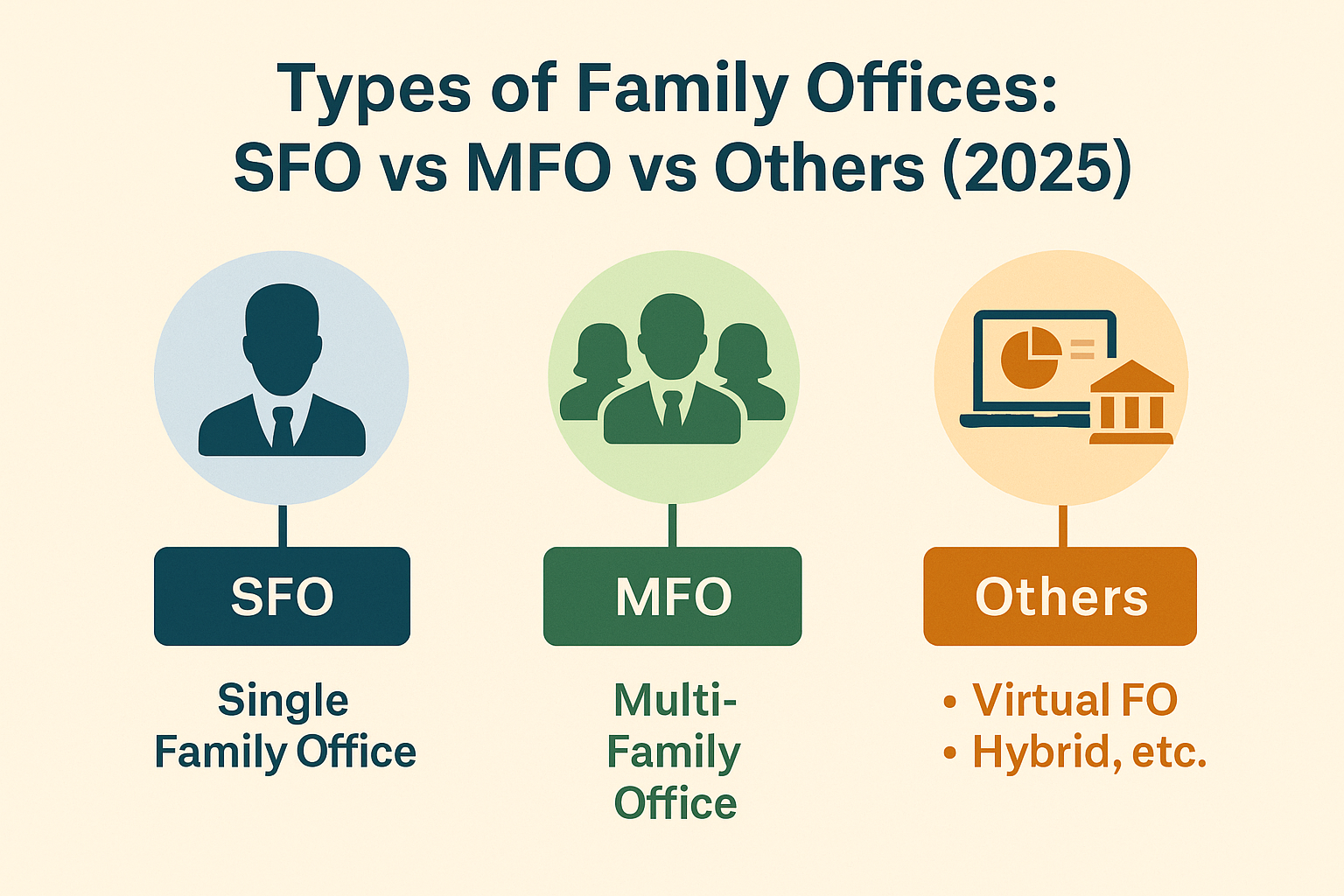
Family offices come in several models depending on a family’s size, complexity, assets, and control preferences. Malaysia’s current incentive scheme focuses primarily on the Single Family Office (SFO), but the broader region sees multiple operational models.
Asia's wealth landscape continues to scale rapidly, and several regional family offices now appear in global top 100 rankings. These offices represent institutional-grade structures built around multi-generational wealth.
| World Rank | Family Office | Country / Region | Owner / Notable Figure |
|---|---|---|---|
| 19 | Hartono Family Office | Indonesia | Hartono Family |
| 21 | Indorama Capital Holdings | Asia | Aloke Lohia |
| 26 | Yoovidhya Family Office | Thailand | Yoovidhya Family (Red Bull) |
| 33 | PremjiInvest | India | Azim Premji |
| 37 | Sunrise Capital Management | Asia | Not publicly disclosed |
| 62 | AT Capital Group | Singapore | Arvind Tiku |
| 81 | Wah Hin & Company | Singapore | Tan Family |
| 84 | Yamauchi No. 10 | Japan | Yamauchi Family (Nintendo) |
| 95 | Catamaran Ventures | India | NR Narayana Murthy |
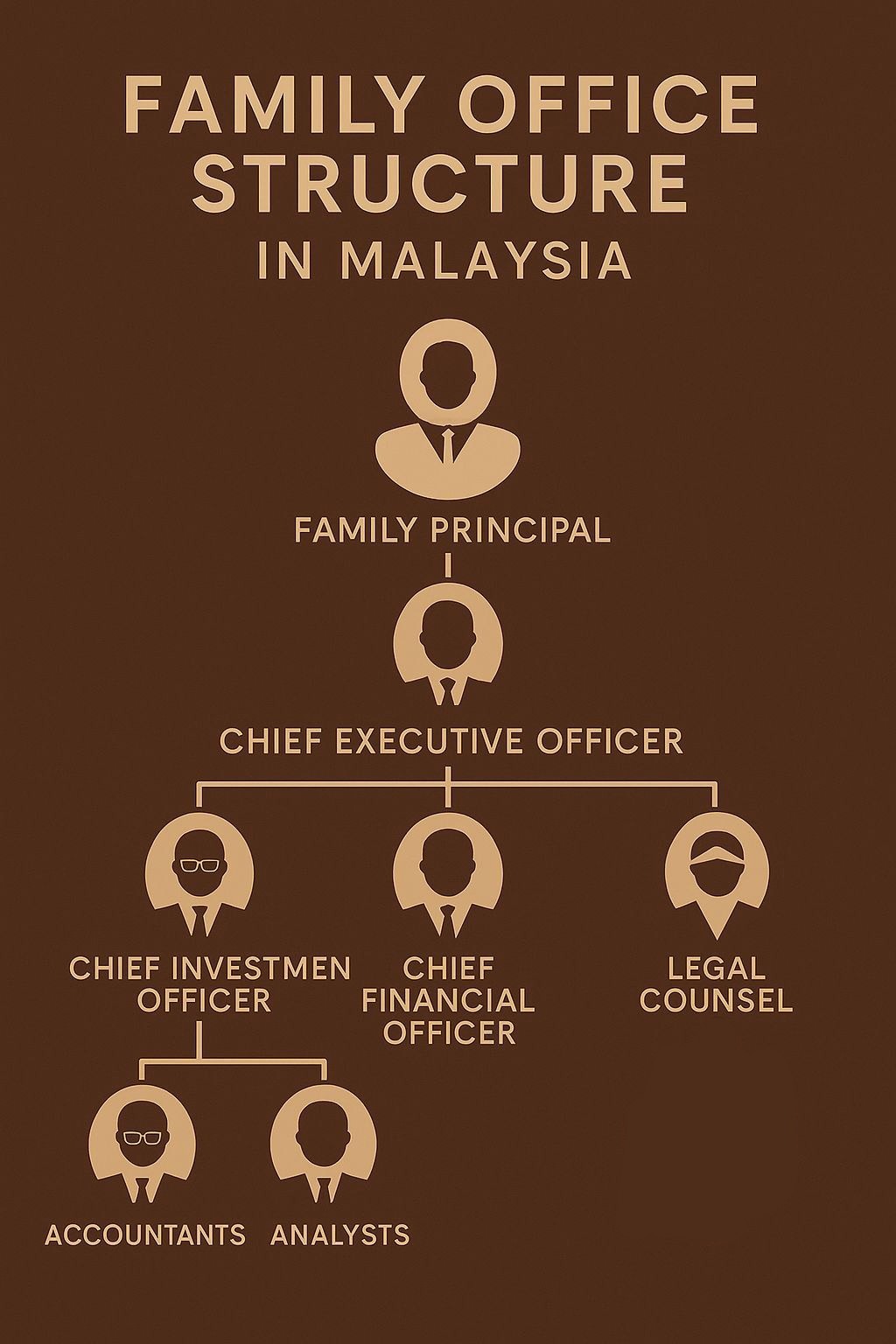
Malaysian family offices are now aligning with global best practices thanks to the newly launched Forest City Special Financial Zone (SFZ) framework. Structures are designed to combine investment control, governance, tax efficiency, and long-term succession planning.
Malaysian family office teams can range from lean 2–4 person setups to full global teams depending on wealth complexity.
Malaysia’s new 0% tax incentive in the Forest City SFZ puts it on the map as a rising family office hub, but the ecosystem still trails Singapore and Hong Kong in maturity, talent depth, and liquidity.
The table below provides a regional comparison:
| Feature | Singapore | Hong Kong | Malaysia |
|---|---|---|---|
| Legal Entities | Pte Ltd, Trust, VCC | LLC, Trust | Sdn Bhd, Trust, Labuan entities |
| Regulator | MAS, ACRA | SFC | SC, SSM, Labuan FSA |
| Tax Incentives | 13O / 13U exemptions | Proposed concessions | 0% tax for SFOV1 in SFZ |
| Market Size | 1,100+ family offices | ~200 family offices | First SFOs launched 2025 |
| Preferred Structures | Holding + fund + FO | Investment vehicles | SFO / SFOV |
| Licensing | SFO exemptions | Licensing required | Registration; exemptions apply |
| Investment Vehicles | VCC, Trusts | LLCs, Trusts | Sdn Bhd, Labuan Foundations |
| Competitiveness | Global leader | Regional powerhouse | Rapidly emerging |
A Family Office is a private wealth management advisory firm that provides a total outsourced solution for managing the financial, investment, and personal affairs of an ultra-high-net-worth individual or family.
The main types are **Single Family Office (SFO)**, which manages wealth for one family (currently offered under the government incentive scheme), and **Multi-Family Office (MFO)**, which serves multiple families, often providing cost-sharing benefits.
The government introduced the **Family Office Incentive Scheme** under the **Forest City Special Financial Zone (SFZ)**, which offers a **0% tax rate** for up to 20 years to eligible **Single Family Office Vehicles (SFOV1)**.
Malaysia offers an accessible entry point through the **Labuan International Business and Financial Centre (Labuan IBFC)**, lowering the requirement to just **RM10 million** in Assets Under Management (AUM). Note that the Forest City SFZ incentive requires a minimum of RM30 million AUM.
Key requirements for the SFOV1 include a minimum of **RM30 million** in managed assets, a minimum annual operational spending of **RM500,000** in Malaysia, and at least **10% of the AUM** or **RM10 million** must be invested locally.
The sector is accelerating rapidly. The Securities Commission (SC) is targeting a fivefold jump to **RM2 billion** in SFO AUM by **2026**, up from RM400 million in 2025.
Yes. Modern Family Offices are tailored to manage new forms of wealth. Malaysia's regulatory openness allows FOs to securely manage emerging assets such as **crypto holdings, NFTs, tokenised assets, and digital art**.
While Singapore and Hong Kong are mature hubs, Malaysia is rapidly improving its competitiveness with the 0% tax incentive in the SFZ and a lower AUM threshold (RM10 million via Labuan), positioning it as a competitive, cost-effective option.
Malaysia’s family office framework is now officially active, and the first SFOs have already gone live. Early adopters—both families and professionals—stand to benefit the most as regulations, talent, and ecosystem support continue to develop.
As the saying goes: the early bird catches the worm. Those who understand family offices now will be best positioned before the next wave of adoption arrives.