
Compare Forest City SFO (0% tax), Labuan trusts and offshore trusts. See AUM, substance, costs, layering strategies and best fit for Malaysians in 2026.

Compare Forest City SFO (0% tax), Labuan trusts and offshore trusts. See AUM, substance, costs, layering strategies and best fit for Malaysians in 2026.

The global family office sector is expanding rapidly — and Malaysia is now positioning itself as one of Asia’s next major family office hubs. From 0% tax incentives to the new Special Financial Zone, 2026 marks a critical turning point.
Here’s everything you need to know about why Family Office in Malaysia is gaining attention now, what opportunities exist, and why talent and readiness remain key challenges.
The global family office sector has grown significantly, managing approximately $3.1 trillion in assets (2024), with projections estimating an increase to $5.4 trillion by 2030.
Notably, the Asia-Pacific region has surpassed Europe in the number of family offices, hosting 2,290 compared to Europe’s 2,020. This highlights Asia’s rising prominence in wealth creation and long-term family governance.
Asia is now the fastest-growing region for ultra-high-net-worth families, driving new demand for advisors, governance experts, and compliant wealth structures.
In Malaysia, 2026 marks a turning point. The Madani Government has introduced the Family Office Incentive Scheme and established the Forest City Special Financial Zone (SFZ), signaling a strong commitment to positioning Malaysia as a competitive family office hub in Southeast Asia.
Below are the key reasons why understanding the family office landscape in Malaysia matters now.
On 20 September 2024, the Malaysian government launched a new Family Office Incentive Scheme under the Forest City Special Financial Zone (SFZ), offering a 0% tax rate for up to 20 years to eligible Single Family Office Vehicles (SFOV1).
| Key Benefits | Description |
|---|---|
| Zero Percent Tax Rate | 20-year tax exemption on income from eligible investments |
| Strategic Location | Must operate within Forest City SFZ with future-ready infrastructure |
| AUM Requirement | Minimum RM30 million assets under management |
| Local Investment | At least 10% of AUM or RM10 million invested locally |
| Operational Spending | Minimum RM500,000 annual OPEX in Malaysia |
For full guidelines, visit the Securities Commission Malaysia announcement .
These incentives raise an important question: Does Malaysia have enough talent, advisory readiness, and ecosystem support to manage the incoming and existing wealth? Today, the answer is largely — not yet.
If you are exploring an international family office, one of Asia’s top firms has now set up in Malaysia. You may make an appointment to speak with their consultant.
Globally, family offices demonstrate massive long-term gains in wealth preservation, governance, and tax optimisation. Here are real examples showing why they matter:
If you are exploring strategic wealth structuring, you may want to review: How to Set Up an Offshore Trust in Malaysia .
By 2027, Asia is expected to have approximately 210,000 ultra-high-net-worth individuals (UHNWIs), each with at least USD 30 million (RM141 million) in wealth. This reflects a growth of nearly 40% from 2022.
With this surge, Asia’s demand for governance advisors, succession planners, trust specialists, and multi-jurisdiction wealth experts is outpacing supply — especially in Malaysia.
This widening talent gap creates opportunities for advisors, financial planners, lawyers, trust officers, and next-gen owners to upskill.
Many high-net-worth individuals in Asia manage their wealth through family offices located in Singapore or Hong Kong. Below is a snapshot of notable individuals with Asia-based family offices:
| Name | Net Worth (2025) | Description | Country | Industry | Family Office Name | Major Investments | Philanthropy | Year Established | Education | Awards |
|---|---|---|---|---|---|---|---|---|---|---|
| Sergey Brin | $143 billion | Co-Founder of Google | Singapore | Technology | Brin Family Office | Real estate, AI startups | Brin Wojcicki Foundation | 2005 | Stanford University | Marconi Prize, National Medal of Technology |
| Mukesh Ambani | $104 billion | Chairman of Reliance Industries | Singapore | Energy, Retail | Reliance Family Office | Oil, telecom, retail | Reliance Foundation | 1981 | Institute of Chemical Technology | Business Leader of the Year |
| Liang Xinjun | $2.3 billion | Co-founder of Fosun Group | Singapore | Investment | Fosun Family Office | Healthcare, real estate | Fosun Foundation | 1992 | Fudan University | Top 10 Chinese Entrepreneurs |
| Ray Dalio | $15.4 billion | Founder of Bridgewater Associates | Singapore | Finance | Dalio Family Office | Hedge funds, global real estate | Dalio Foundation | 1975 | Harvard Business School | Philanthropist of the Year |
| Jack Ma | $27.2 billion | Founder of Alibaba Group | Hong Kong | Technology, E-commerce | Lakeside Partners | E-commerce, fintech, AI | Jack Ma Foundation | 1999 | Hangzhou Normal University | Asia’s Heroes of Philanthropy |
| Li Ka-shing | $31.0 billion | Hong Kong business magnate | Hong Kong | Conglomerate | Horizon Ventures | Biotech, real estate, tech | Li Ka Shing Foundation | 1950 | None | Grand Bauhinia Medal |
| Joseph Tsai | $12.1 billion | Co-Founder of Alibaba Group | Hong Kong | Technology, Investment | Blue Pool Capital | Sports franchises, private equity | Tsai Foundation | 2012 | Yale University | Business Person of the Year |
| James Dyson | $15.1 billion | Founder of Dyson | Singapore | Technology, Consumer Goods | Weybourne Group | Tech, robotics, property | James Dyson Foundation | 2013 | Royal College of Art | Order of Merit, Royal Designer for Industry |
Many wealthy Malaysians currently structure their wealth abroad due to Malaysia’s talent gap and limited family office ecosystem. CEOs in Asia’s family office sector earn between SGD 158,001 and SGD 500,000 annually (KPMG) — excluding bonuses — reflecting the specialised nature of the industry.
FIAM is committed to helping Malaysia close this gap by training advisors with international family office experts. Subscribe below to receive updates on family office Malaysia, offshore trusts, and inheritance planning.
Traditionally, establishing a family office required high entry thresholds:
In contrast, Malaysia — through the Labuan International Business and Financial Centre (Labuan IBFC) — now allows family office structures with a minimum of just RM10 million AUM.
This policy change is expected to:
Malaysia’s family office expansion is already underway. According to The Star, the Securities Commission (SC) reported that Malaysia’s Single Family Office assets under management reached RM400 million in 2025.
Powered by clearer SC guidelines and the 0% tax incentive from the Forest City Special Financial Zone (SFZ), Malaysia is rapidly becoming an attractive destination for wealth owners.
Even more striking, the SC targets RM2 billion in SFO AUM by 2026 — a fivefold leap in just one year.
This shows that Malaysia is no longer “planning” to enter the global family office arena — it is already scaling and attracting serious interest.
Modern family offices are expanding beyond traditional assets. Today’s portfolios increasingly include crypto holdings, NFTs, tokenised assets, and digital art.
Malaysia’s regulatory openness and flexibility position it as a promising jurisdiction for families who want secure, compliant ways to structure emerging digital wealth.
As digital assets become mainstream, Malaysia’s early framework gives it a competitive edge among Asian financial centres.
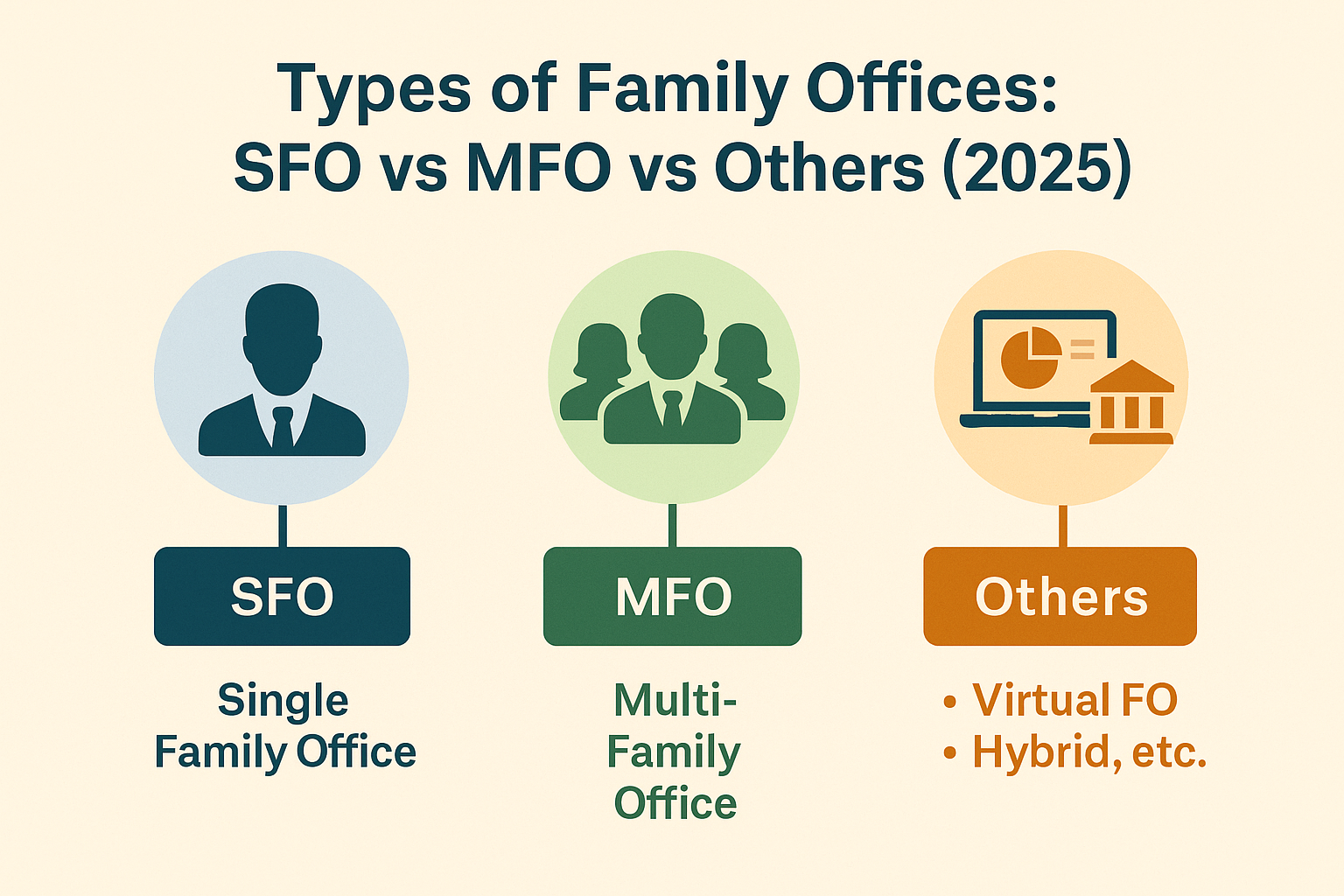
Family offices come in several models depending on a family’s size, complexity, assets, and control preferences. Malaysia’s current incentive scheme focuses primarily on the Single Family Office (SFO), but the broader region sees multiple operational models.
Asia's wealth landscape continues to scale rapidly, and several regional family offices now appear in global top 100 rankings. These offices represent institutional-grade structures built around multi-generational wealth.
| World Rank | Family Office | Country / Region | Owner / Notable Figure |
|---|---|---|---|
| 19 | Hartono Family Office | Indonesia | Hartono Family |
| 21 | Indorama Capital Holdings | Asia | Aloke Lohia |
| 26 | Yoovidhya Family Office | Thailand | Yoovidhya Family (Red Bull) |
| 33 | PremjiInvest | India | Azim Premji |
| 37 | Sunrise Capital Management | Asia | Not publicly disclosed |
| 62 | AT Capital Group | Singapore | Arvind Tiku |
| 81 | Wah Hin & Company | Singapore | Tan Family |
| 84 | Yamauchi No. 10 | Japan | Yamauchi Family (Nintendo) |
| 95 | Catamaran Ventures | India | NR Narayana Murthy |
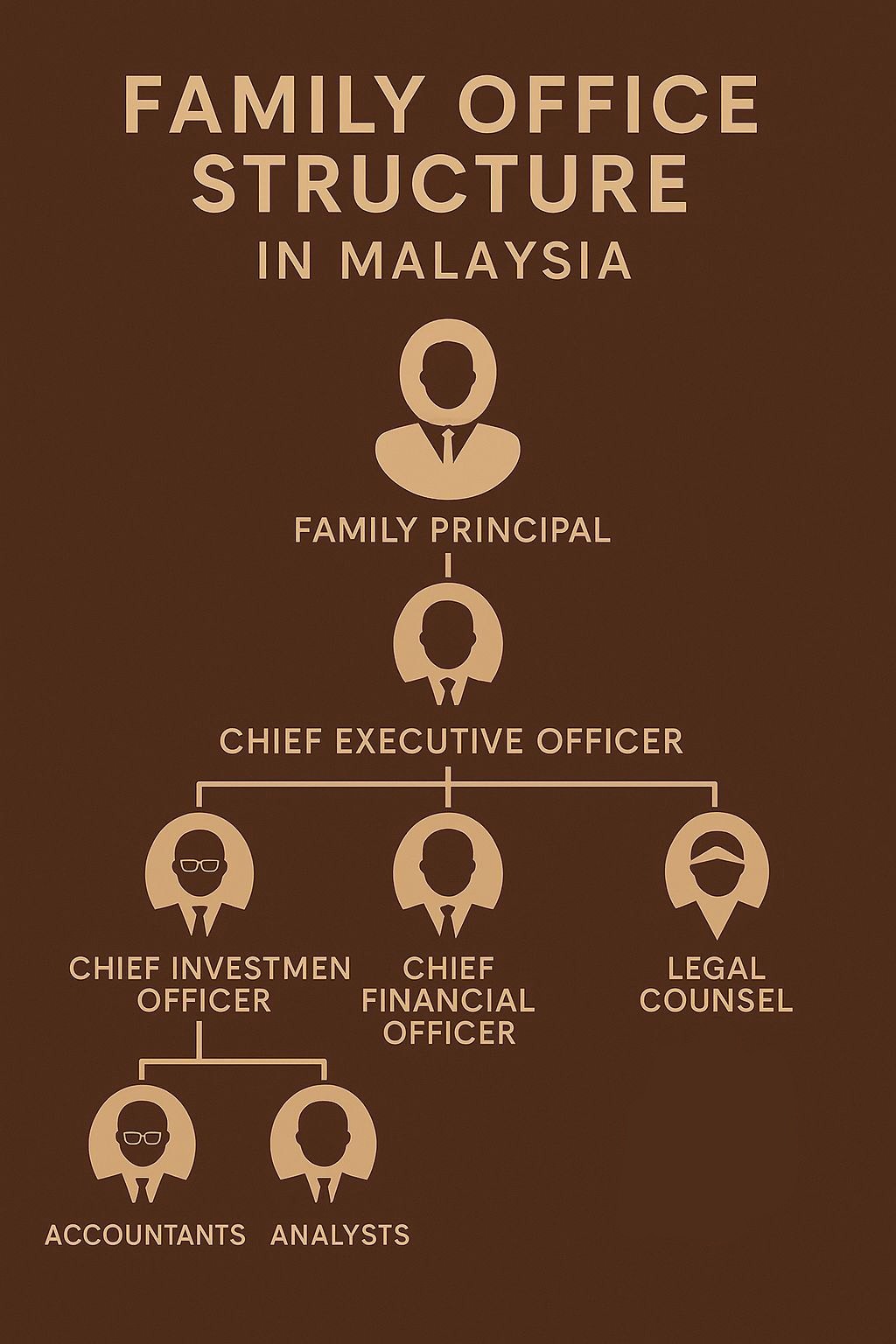
Malaysian family offices are now aligning with global best practices thanks to the newly launched Forest City Special Financial Zone (SFZ) framework. Structures are designed to combine investment control, governance, tax efficiency, and long-term succession planning.
Malaysian family office teams can range from lean 2–4 person setups to full global teams depending on wealth complexity.
Malaysia’s new 0% tax incentive in the Forest City SFZ puts it on the map as a rising family office hub, but the ecosystem still trails Singapore and Hong Kong in maturity, talent depth, and liquidity.
The table below provides a regional comparison:
| Feature | Singapore | Hong Kong | Malaysia |
|---|---|---|---|
| Legal Entities | Pte Ltd, Trust, VCC | LLC, Trust | Sdn Bhd, Trust, Labuan entities |
| Regulator | MAS, ACRA | SFC | SC, SSM, Labuan FSA |
| Tax Incentives | 13O / 13U exemptions | Proposed concessions | 0% tax for SFOV1 in SFZ |
| Market Size | 1,100+ family offices | ~200 family offices | First SFOs launched 2025 |
| Preferred Structures | Holding + fund + FO | Investment vehicles | SFO / SFOV |
| Licensing | SFO exemptions | Licensing required | Registration; exemptions apply |
| Investment Vehicles | VCC, Trusts | LLCs, Trusts | Sdn Bhd, Labuan Foundations |
| Competitiveness | Global leader | Regional powerhouse | Rapidly emerging |
A Family Office is a private wealth management advisory firm that provides a total outsourced solution for managing the financial, investment, and personal affairs of an ultra-high-net-worth individual or family.
The main types are **Single Family Office (SFO)**, which manages wealth for one family (currently offered under the government incentive scheme), and **Multi-Family Office (MFO)**, which serves multiple families, often providing cost-sharing benefits.
The government introduced the **Family Office Incentive Scheme** under the **Forest City Special Financial Zone (SFZ)**, which offers a **0% tax rate** for up to 20 years to eligible **Single Family Office Vehicles (SFOV1)**.
Malaysia offers an accessible entry point through the **Labuan International Business and Financial Centre (Labuan IBFC)**, lowering the requirement to just **RM10 million** in Assets Under Management (AUM). Note that the Forest City SFZ incentive requires a minimum of RM30 million AUM.
Key requirements for the SFOV1 include a minimum of **RM30 million** in managed assets, a minimum annual operational spending of **RM500,000** in Malaysia, and at least **10% of the AUM** or **RM10 million** must be invested locally.
The sector is accelerating rapidly. The Securities Commission (SC) is targeting a fivefold jump to **RM2 billion** in SFO AUM by **2026**, up from RM400 million in 2025.
Yes. Modern Family Offices are tailored to manage new forms of wealth. Malaysia's regulatory openness allows FOs to securely manage emerging assets such as **crypto holdings, NFTs, tokenised assets, and digital art**.
While Singapore and Hong Kong are mature hubs, Malaysia is rapidly improving its competitiveness with the 0% tax incentive in the SFZ and a lower AUM threshold (RM10 million via Labuan), positioning it as a competitive, cost-effective option.
Malaysia’s family office framework is now officially active, and the first SFOs have already gone live. Early adopters—both families and professionals—stand to benefit the most as regulations, talent, and ecosystem support continue to develop.
As the saying goes: the early bird catches the worm. Those who understand family offices now will be best positioned before the next wave of adoption arrives.


In Malaysia, an estimated 80% of Malaysians do not possess valid wills, increasing the likelihood of frozen assets and family disputes. This guide explains why estate planning matters and compares wills, trusts, and family office solutions so you can choose the right tool.
Estate planning is particularly important for several reasons:
The lack of clear estate planning can lead to severe family conflicts, sometimes resulting in legal battles and even violence.
Proper estate planning can help ensure loved ones remain financially secure and assets are distributed according to your wishes.
Effective planning can reduce exposure to creditor risk, especially for business owners, by improving how assets are structured and separated.
Conflicts over inheritance frequently arise due to inadequate estate planning in Malaysia — affecting small families and ultra-rich households.
The purpose of this blog post is to help you understand the differences and benefits of each estate planning tool by comparing wills, trusts, and family offices. As you can see, the absence of proper planning can lead to significant conflicts and complications. Therefore, it is essential to consider tools like private trusts and offshore trusts, in addition to wills and family office solutions, to improve protection and ensure your wishes are honored.
Definition and Purpose: A will is a legal document that sets forth your wishes regarding the distribution of your property and the care of any minor children.
Advantages
Disadvantages
Suitable for: Straightforward estate situations with clear directives for asset distribution.
Definition and Purpose: A fiduciary arrangement that allows a third party (trustee) to hold assets on behalf of beneficiaries.
Types of Trusts: Living trust, testamentary trust, offshore trust.
Advantages
Disadvantages
Suitable for: Complex estates, asset protection, privacy concerns, international asset management, and planning for incapacitation.
Definition and Purpose: A private wealth management advisory setup that serves high-net-worth families, providing integrated services including estate planning, tax services, investment management, and family governance.
Advantages
Disadvantages
Suitable for: Very wealthy families needing a holistic approach to wealth management, governance, and succession.
There have been ongoing calls for greater public awareness and initiatives in estate planning to reduce frozen assets and improve how dependents access inheritance. On the family office side, Malaysia has also announced a Single Family Office incentive scheme connected to Forest City’s SFZ, with the Securities Commission outlining a 0% concessionary tax rate on income generated by eligible investments under the scheme.
Note: Incentives and eligibility criteria can change. Always confirm the latest rules with a licensed professional advisor before implementing.
Below is a practical comparison based on typical team involvement, indicative fees, and who normally needs each service.
| Service | Team Members | No. of Professionals | Typical Fees (MYR) | Who Normally Needs It |
|---|---|---|---|---|
| Will & Estate Planning Firm | Will Drafting Expert, Legal Advisor, Estate Planner, Tax Advisor, Financial Planner | 4–5 | RM500 – RM50,000 (one-time) | Straightforward to complex estates; higher net worth; guardianship + asset distribution clarity |
| Private Trust | Trustee, Trust Administrator, Legal Advisor, Financial Advisor, Tax Advisor | 5 | RM10,000 – RM50,000 / year | Families wanting continuity, privacy, and structured distributions; probate avoidance for transferred assets |
| Offshore Trust | Trustee, Trust Administrator, Legal Advisor, Financial Advisor, Tax Advisor, Compliance Officer, Asset Protection Specialist | 7 | RM20,000 – RM100,000 / year | Offshore assets or multi-jurisdiction planning; higher complexity and compliance needs |
| Family Office | CEO/Director, CFO, Investment Manager, Legal Counsel, Tax Advisor, Philanthropy Advisor, Family Governance Advisor, Admin Staff, PAs, Estate Manager | 10+ | RM100,000 – RM500,000 / year | Ultra-high net worth families needing total governance + investment + succession + lifestyle coordination |
*Fees are indicative and vary by complexity, jurisdiction, and required compliance.
A Will is usually the starting point. But if you have a business, vulnerable beneficiaries, complex assets, or multi-jurisdiction exposure, a trust and governance plan may be needed for continuity.
Signing documents but not implementing the structure (e.g., not transferring assets, not updating bank/ownership arrangements, unclear trustee powers).
Typically when wealth is large, assets are diversified (business + property + investments), and you need governance and long-term coordination across generations.
List your assets, ownership type (personal vs company), and intended beneficiaries. From there, choose the correct combination: Will + Trust + governance (if needed).
Taking the first step is crucial to ensuring your assets are protected and your wishes are honored. FIAM, in collaboration with Timeless Family Office, is offering a complimentary 30-minute consultation to help you get started.
*Daily slots are limited. Please mention FIAM 2026 Guide when booking.
Setup a Labuan Family Office in 2026. Compare Private Fund vs Waqf structures, understand requirements, and see the new FSA fee revisions.
Compare Malaysia vs Singapore Family Office setups for 2026. . A complete guide on licensing, AUM thresholds, and strategic benefits
A comprehensive 2026 guide on how to set up a family office in Malaysia, covering structure, compliance, incentives, and cross-border options.
Malaysia’s #1 guide to family office courses: trusts, foundations, cross-border tax & governance. Start local, add online, certify with AFIP.
ESG Investing Malaysia is transforming how wealth is preserved, managed, and passed on. ESG is not just a trend, it is both a risk management strategy and a legacy tool.


As the global financial landscape evolves, the influence of the crypto asset market is becoming increasingly significant. Hong Kong, as an international financial hub, is capturing this trend by upgrading its regulatory measures to foster the development of the crypto asset market.